

Enterprise IT services / system integration
Enterprise system integration
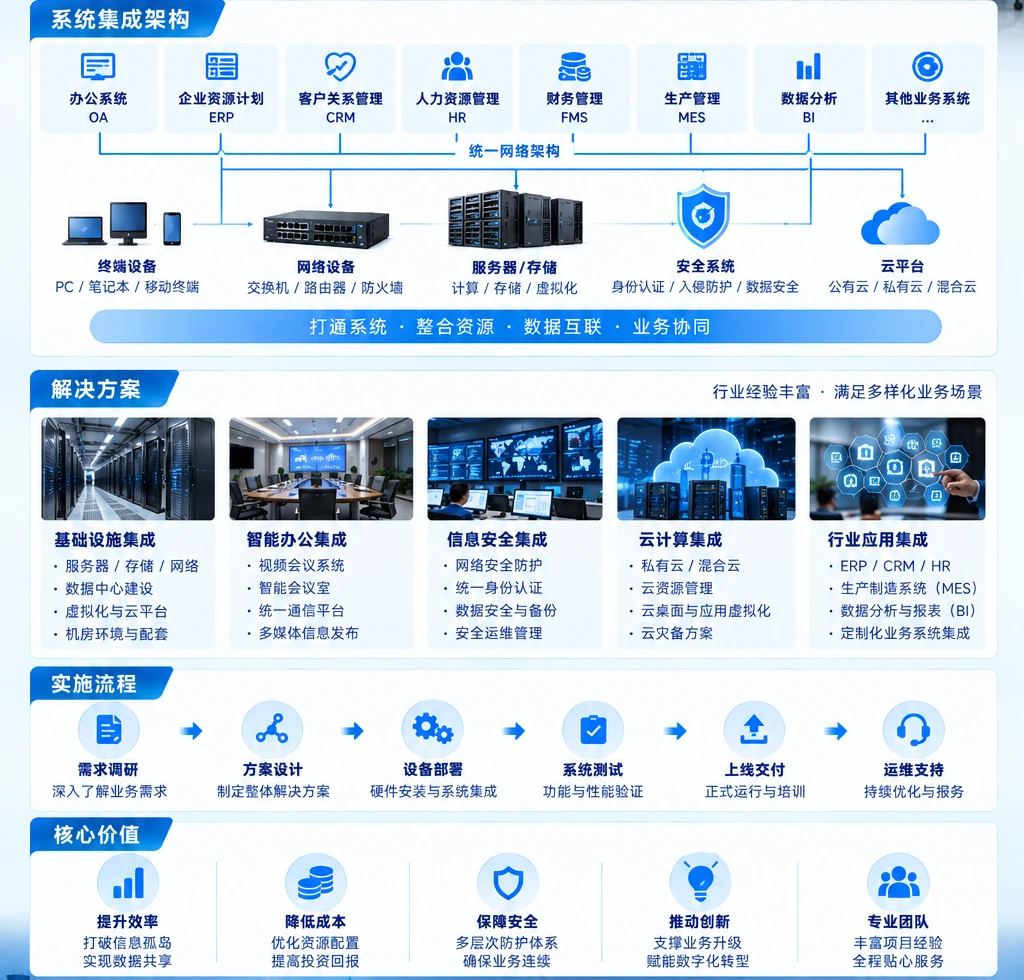
System integration is not simply assembling equipment. It brings site conditions, network security, compute and storage, business applications, and operational handover into one executable plan.
01 Plan the whole relationship first
Bring the site, equipment and delivery
into one implementation plan
System integration coordinates the site, equipment, links, systems and delivery responsibilities through one implementation plan.
When cabling, networking, servers, storage, business systems and maintenance teams move separately, equipment may be in place while nobody can answer how it connects, who owns each handoff, or how it will be accepted.
- Site conditionsThe server room, low-voltage works, power, cable routes and equipment positions determine what can be implemented.
- System relationshipsNetwork and security boundaries, compute and storage, and application interfaces must follow real dependencies.
- Delivery responsibilityClear tests, documentation and contacts give the next operations team something they can take over.
02 Coordination relationships
Make the systems work together
Yuqi Intelligent checks the relationships among networking, servers, storage, security and applications, then coordinates multi-system integration testing and unified delivery. The diagram shows five inputs being validated by a central platform.
Networking, servers, storage, security and applications enter in parallel with staggered timing. After connection checks and integration testing in the central platform, they converge into one delivery. This is a fan-in topology, not a timeline of process cards.
- 01 / inputnetworkLinks, addressing and security boundaries
- 02 / inputserverCompute, virtualization and interfaces
- 03 / inputstorageCapacity, performance and data paths
- 04 / inputsecurityAccess, policy and audit conditions
- 05 / inputapplicationInterfaces, migration and integration relationships
- Platform / validationCentral integration platformAccess validation · integration orchestration · delivery checks
- Unified deliveryAn accepted deliveryTests, documentation and responsibility boundaries
One implementation boundary connects site work, equipment configuration, interface testing and operations documentation into a delivery path that can be checked.
03 What Yuqi Intelligent can deliver
Integration services from Yuqi Intelligent
Yuqi Intelligent coordinates equipment, site work and system dependencies around the existing environment and business goals, so the project goes beyond a purchasing list.
Requirements survey and solution design
Review site conditions, existing equipment, business goals, network boundaries and implementation constraints to define a solution and scope that can be discussed.
Equipment selection and supply
Organize server, storage and network selection and supply around compatibility, capacity, interfaces, installation conditions and lifecycle.
Site installation and cabling coordination
Coordinate the server room, low-voltage works, racks, power, links and endpoint positions, including construction interfaces and equipment installation.
Network configuration
Configure and check switching, routing, addressing, segmentation, security boundaries and related foundational services.
Migration, interfaces and integration testing
Connect old and new systems, network paths and business interfaces within the confirmed scope, then support integration testing and issue isolation.
Acceptance testing and documentation handover
Complete the agreed tests and hand over configuration, topology, port, change and contact records to the operations team.
04 What the client receives
A complete delivery with a clear maintenance path
When one implementation boundary connects the site, equipment, configuration and documentation, the project can answer three practical questions: where work can happen, who owns each segment, and how operations continue after handover.
- Requirements and current-state record
- Solution, topology and equipment list
- Configuration, migration and integration record
- Acceptance tests and handover material
Actual deliverables depend on site conditions and the scope confirmed by both parties.
Reduce coordination overhead
Summarize the site, equipment, network and interface work fronts early, then route issues by object and responsibility.
Fewer missed interfaces
Cabling, addressing, network segments, equipment configuration and business integration testing follow one checklist.
Documentation is easier to take over
Topology, ports, configuration, test records and contacts arrive with the project for later maintenance and change work.
05 Start a conversation
Start with the current site and one concrete problem
If you are building, modernizing or integrating networking, servers, storage, a server room or business infrastructure, start with the site overview, existing equipment, current issue and target timing.
Is system integration just buying a few devices?
No. Equipment is only the foundation; site conditions, network and security boundaries, compute and storage, business interfaces, and testing and handover must also connect.
Can existing equipment and business systems be planned together?
Yes. Start by checking existing equipment, capacity, interfaces, permissions and business dependencies, then decide what to retain, replace, migrate and integrate.
How does a project start?
Share the site overview, existing equipment, current issue and target timing. We start with a requirements survey and implementation-boundary review.