

ENTERPRISE HIGH-PERFORMANCE COMPUTING
High-Performance Computing (HPC)
Organize an expandable, schedulable and verifiable high-performance computing environment around CPU/GPU nodes, high-speed networking, shared storage and job scheduling.
01 Why planning matters
The scale of parallel work
determines how the computing environment is organized.
Building HPC is not simply adding servers. Nodes and resources are planned around parallel workloads, data scale, compute type and runtime.
Compute, data and interconnect paths affect one another; adding one resource type alone often does not improve overall job efficiency.
-
01
Centralized compute scheduling
Organize distributed CPU, GPU and memory into an allocatable compute pool.
-
02
Clear jobs and priorities
Allocate compute resources by job demand, queue and business priority.
-
03
High-speed data paths
Match compute nodes, shared storage and network paths to actual data throughput.
-
04
Verifiable operating results
Keep task, resource, version, failure and result records for continuous improvement.

02 PLATFORM ARCHITECTURE
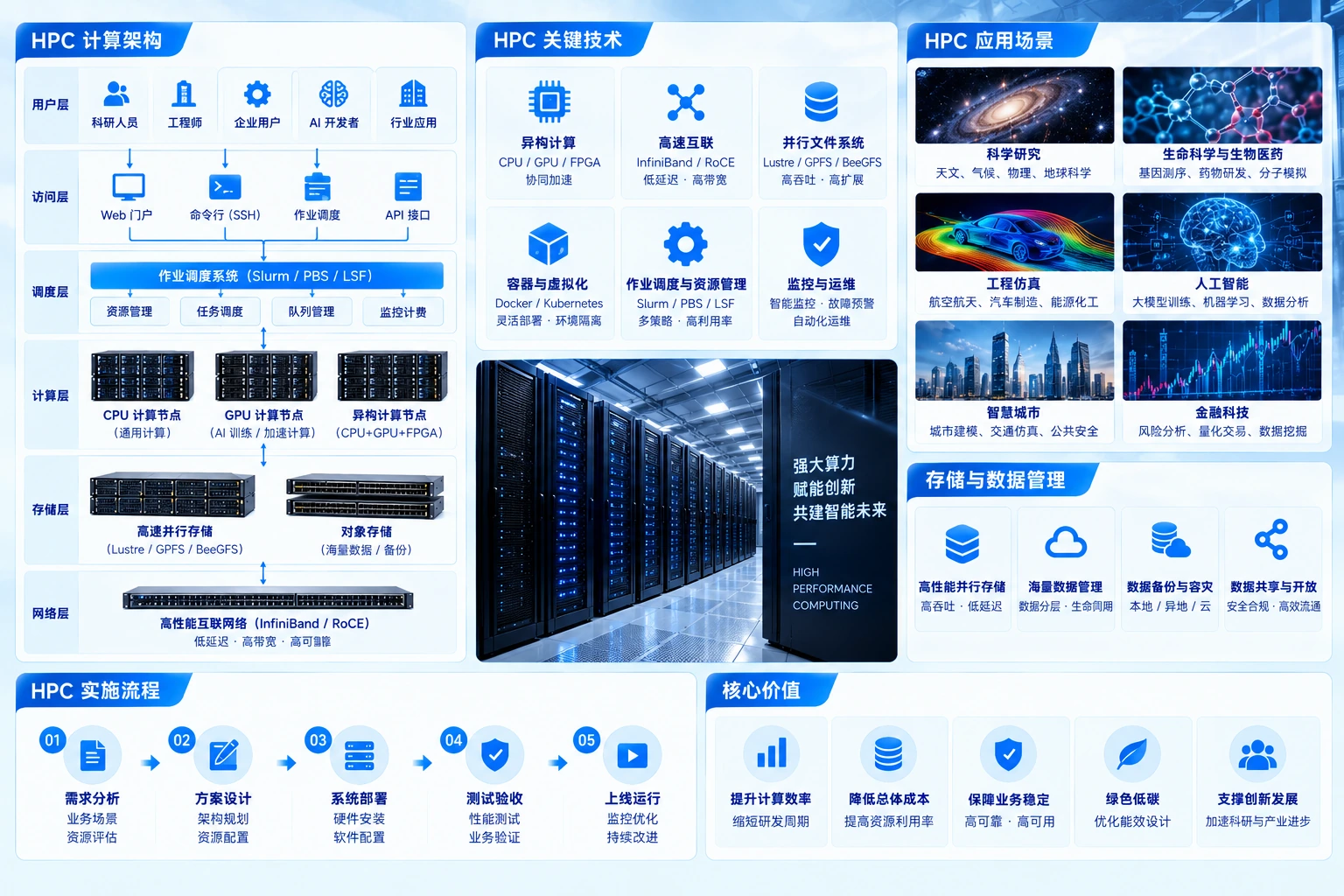
Compute, networking and storage
must be designed together around the data path.
Data movement, node interconnects and shared storage directly affect job efficiency, so the architecture starts with the real data path.
HPC-ENV · system view 01/01
Waiting for node-to-node communication directly affects parallel job efficiency.
Data throughput and access patterns shape storage-path design.
Queue and resource status feed back into continuous policy adjustment.
The architecture follows the real data path and does not assume a fixed equipment scale.
03 JOB SCHEDULING
From benchmarking to job scheduling
validate cluster capability step by step.
Implementation validates hardware, systems, the scheduler, software environment and usage workflow together; powering on equipment is not enough.
- 01Requirements and baseline
Confirm task type, dataset, parallel method and performance measures.
- 02Cluster deployment
Complete node, network, storage, system and scheduler configuration.
- 03Job validation
Use representative jobs to validate queues, resources, failure and recovery.
- 04Operations handover
Hand over nodes, queues, software environment, monitoring and maintenance records.


04 COMPUTE DENSITY
Compute density and interconnect method
together with cooling and power determine node capability.
Node specifications should follow compute density, interconnect method and the expansion plan; GPU nodes, high-speed fabric and cooling conditions together determine high-density capability.
-
01
Task type
Separate CPU, GPU, memory, parallel and batch tasks.
-
02
Node specifications
Select nodes around compute density, interconnect method and the expansion plan.
-
03
Resource pool
Bring nodes, quotas, queues and usage permissions into unified scheduling.

05 OPERATIONS
Operations focus on resource utilization,
jobs and failures.
Stable cluster operations require continued attention to resource use, queued tasks, software versions, storage capacity and node state.
-
01
Resources and queues
Adjust quotas, queues and resource allocation as tasks change.
-
02
Software environment
Manage drivers, runtimes, images and application-version baselines.
-
03
Failure and recovery
Record the causes of node, network, storage and job failures.
06 DELIVERY
One verifiable delivery path.
-
01
Site inventory
Inventory the current environment and build conditions, then confirm the implementation boundary.
-
02
Architecture and configuration design
Define node, network and storage options around task characteristics.
-
03
Installation and integration testing
Complete equipment installation and system, scheduler and network integration testing.
-
04
Scenario and failure testing
Use representative jobs to validate performance, failure and recovery behavior.
-
05
Documentation and operations handover
Hand over topology, configuration, monitoring and contact records.

START A CONVERSATION
Start with task characteristics
to plan your high-performance computing environment.
supports@yuqi-sh.com Contact information is for project communication only